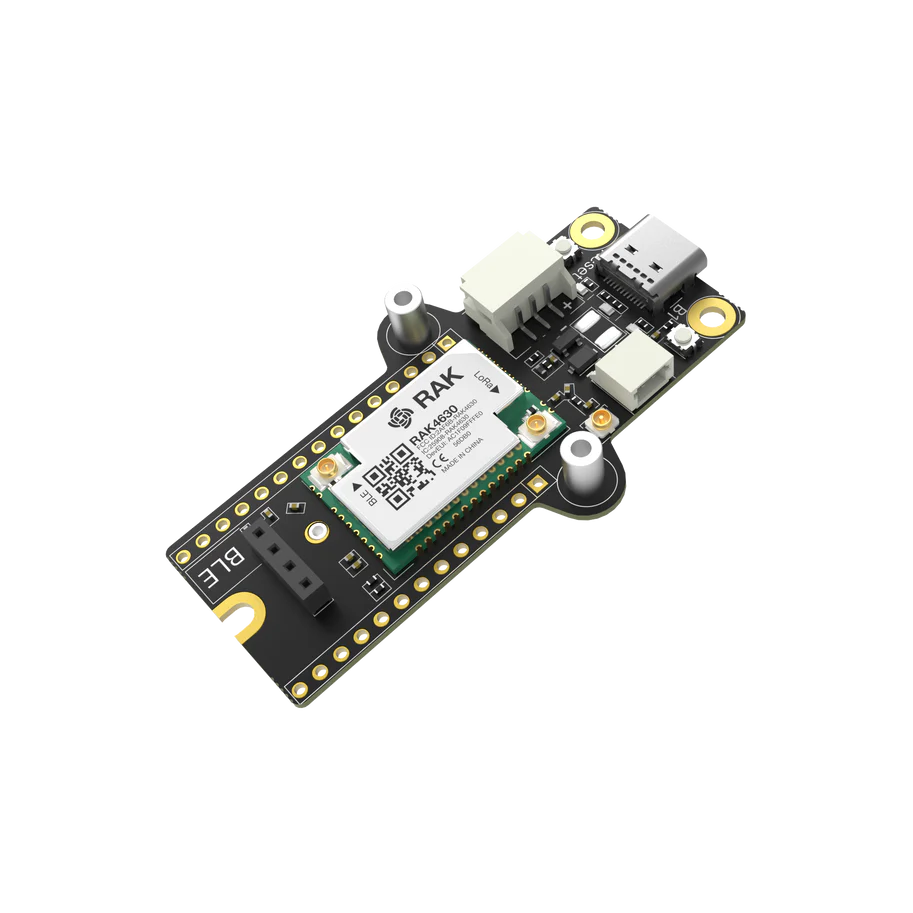
RAK WisMesh Board ONE
The WisMesh Board ONE is a compact and extensible Meshtastic device, available as a baseboard for development or with an enclosure for portable, handheld use. Designed for versatility, it features exposed GPIOsGPIO (General Purpose Input/Output). An uncommitted digital signal pin on a device. for expansion and a WisBlock sensor slot for added functionality. With its low-power efficiency and flexible design, the Board ONE is ideal for customized projects or ready-to-use deployments in off-grid communication networks.
Specifications
- Base Board
- Board ONE
- MCUMCU (Microcontroller Unit). The microcontroller that runs the firmware on a device. The hardware tables list the MCU for each supported board.
- RAK4630 (nRF52840)
- Bluetooth BLEBLE (Bluetooth Low Energy). The default wireless connection between a node and a phone client. 5.0
- Very low power consumption
- RAK4630 (nRF52840)
- LoRaLoRaA low-power, long-range wireless communication technology used by Meshtastic devices to enable communication over distances of several kilometers without the need for cellular, Wi-Fi, or other traditional network infrastructures. Transceiver:
- SX1262SX1262A Semtech sub-GHz LoRa transceiver, used in most current Meshtastic hardware and recommended over the older SX127x series.
- Frequency Options:
- 868 MHzMHz (Megahertz). A unit of frequency equal to one million hertz (cycles per second), used to specify the operating frequency of LoRa devices in the Meshtastic network, affecting range and data rate.
- 915 MHzMHz (Megahertz). A unit of frequency equal to one million hertz (cycles per second), used to specify the operating frequency of LoRa devices in the Meshtastic network, affecting range and data rate.
- 920 MHzMHz (Megahertz). A unit of frequency equal to one million hertz (cycles per second), used to specify the operating frequency of LoRa devices in the Meshtastic network, affecting range and data rate.
- 923 MHzMHz (Megahertz). A unit of frequency equal to one million hertz (cycles per second), used to specify the operating frequency of LoRa devices in the Meshtastic network, affecting range and data rate.
- Connectors:
- USBUSB (Universal Serial Bus). The wired connection used to power a device, flash firmware onto it, and communicate with it over serial.-C
- JSTJSTA small keyed board connector used for battery and solar leads, such as PHR-2 for a LiPo battery and ZHR-2 for solar input. PHR-2 connector for 3.7v LiPo battery.
- JSTJSTA small keyed board connector used for battery and solar leads, such as PHR-2 for a LiPo battery and ZHR-2 for solar input. ZHR-2 connector for 5v solar panel.
Features
- 1.3-inch OLEDOLED (Organic Light-Emitting Diode). A display type used on many Meshtastic devices. The OLED Type setting selects which panel driver the firmware uses. display
- All GPIOsGPIO (General Purpose Input/Output). An uncommitted digital signal pin on a device. and system buses are exposed on pin headers
- On-PCB BLEBLE (Bluetooth Low Energy). The default wireless connection between a node and a phone client. antenna
- IPEXIPEXA miniature coaxial antenna connector found on many boards. The docs write it as U.FL/IPEX, using the two names interchangeably. connector for internal or external LoRaLoRaA low-power, long-range wireless communication technology used by Meshtastic devices to enable communication over distances of several kilometers without the need for cellular, Wi-Fi, or other traditional network infrastructures. antenna.
- User button and firmware controlled LEDLED (Light-Emitting Diode). An indicator light on a device. The External Notification module can drive one in response to mesh activity.'s
- One WisBlock compatible Sensor Slot (e.g. to add a GNSSGNSS (Global Navigation Satellite System). A multi-constellation satellite positioning receiver. Hardware listing GNSS support typically receives GPS, BeiDou, GLONASS and QZSS. location module RAK12500)
Resources
- Firmware file:
firmware-rak4631-X.X.X.xxxxxxx.uf2 - Further information on the WisMesh Board ONE can be found on the RAK Documentation Center.
- Purchase Links:
- US
- International
- Bare Version
- Pocket Version